 Ella Verbs
Spanish Verb Sudoku
The conjugation puzzle that makes you think, not just memorize. Play online or print free worksheets with answer keys.
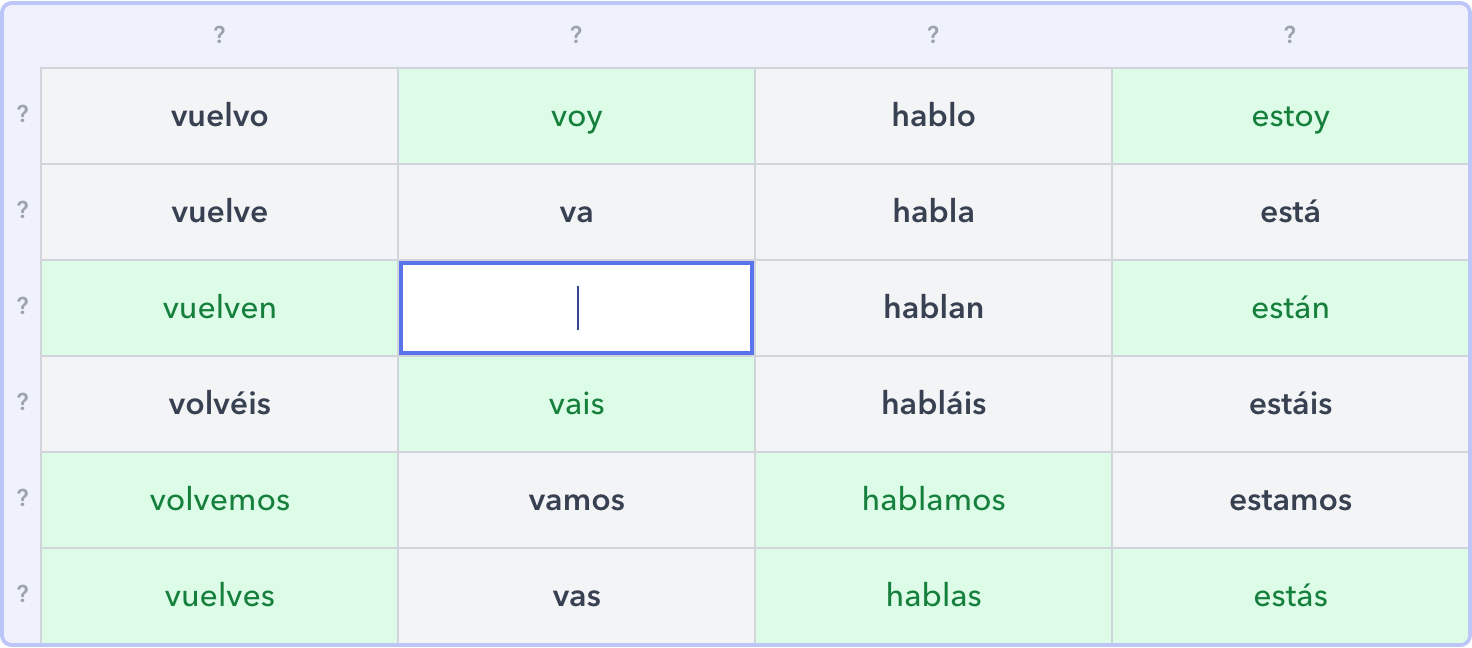
Choose your verbs, tenses, and difficulty. No signup required.
📅 Today's puzzle: ·
What is Spanish verb sudoku?
Spanish verb sudoku is a puzzle game where you fill a grid with conjugated verb forms instead of numbers. Each row is a pronoun (yo, tú, él/ella, nosotros, ellos) and each column is a verb-and-tense combination. Your job is to figure out the correct conjugation for every cell.
But here's the twist: the row and column labels are hidden. You're not told which pronoun is which row, or which verb and tense belong to each column. Instead, you get a handful of pre-filled cells as clues, and you have to work backwards, using pattern recognition and cross-referencing to deduce everything else.
That means you're not just recalling "yo hablo." You're looking at "hablo" and reasoning that it must be yo, present tense, then using that deduction to unlock the rest of the row and column. It's the difference between a flashcard and a real conversation, where you hear a conjugated verb and need to figure out who's doing what.
A few key details:
- Grids are 5 or 6 rows (depending on whether you include vosotros) by 4–6 columns
- Three modes: Single Verb (one verb across multiple tenses), Single Tense (one tense across different verbs), or Mixed (each column is a unique verb+tense combo)
- Difficulty controls how many cells are pre-filled: Easy (over 50%), Medium (30-50%), Hard (less than 30%)
- Every puzzle is solvable – the algorithm guarantees enough clues to disambiguate forms that might otherwise look identical (like yo and él in the subjunctive imperfect)
Why verb sudoku is a great way to practice
Learning conjugations is one thing. Recognizing them in the wild is another. Spanish verb sudoku tests your knowledge in a different direction – instead of being told the verb, tense, and pronoun and producing the form, you start with conjugated forms and reason backwards.
It builds pattern recognition
You learn to recognize verb forms from their shape – the endings, the stem changes, the irregularities – which is exactly what you need when reading Spanish or listening to a conversation.
It forces cross-referencing
A single cell is often ambiguous. "Hablaba" could be yo or él in the imperfect. You have to look at other cells in the same row to figure it out. That process of cross-referencing mirrors how you actually parse meaning in context.
Every deduction cascades
Once you identify a row as "nosotros," every blank cell in that row is suddenly constrained. One insight unlocks multiple answers, which is satisfying and reinforces entire conjugation patterns rather than isolated forms.
The difficulty scales with your knowledge
Easy mode gives you enough context to figure out almost everything from the clues. Hard mode requires you to hold more conjugation knowledge in your head already. It meets you where you are.
For Spanish teachers: free, printable, no-prep conjugation puzzles
If you're a Spanish teacher looking for engaging verb conjugation activities, this tool was built with you in mind.
Generate unlimited PDF worksheets, completely free. Choose your verbs, your tenses, and your difficulty level, then hit "Generate Worksheets." You'll get a printable PDF with puzzles and a full answer key. No account required. No email gate. No limit on how many you create.
Customize to match your curriculum. Teaching present tense -AR verbs this week? Set it to Single Tense, select present indicative, filter for regular -AR verbs, and generate. Moving on to preterite irregulars next week? Change the settings and print a new batch. You can target the top 100 most common verbs, the top 300, or pick specific verbs by name.
Use it however fits your class. These puzzles work as warm-up activities, homework assignments, early-finisher tasks, review before exams, or low-prep sub plans. The deduction element means students stay engaged longer than with standard fill-in-the-blank worksheets, because they're solving a puzzle, not completing a drill.
Or let students play online. The interactive version gives instant feedback: correct answers turn green, incorrect answers turn red, and close-but-missing-an-accent answers get a yellow warning. There's also an "Explain" button that walks students through the conjugation step by step when they get something wrong. You can project it in class or assign it as a digital activity.
It works across levels. Beginners can start with easy difficulty, present tense, regular verbs, where most of the grid is already filled in and the patterns are predictable. Advanced students can tackle hard difficulty, mixed mode, with subjunctive and conditional tenses in the mix.
What you can do
Play the Daily Puzzle
A new puzzle every day using the top 100 Spanish verbs. The mode rotates daily. Great for building a daily practice habit.
Build Custom Puzzles
Pick your mode (single verb, single tense, or mixed), choose from 7 simple tenses or toggle to include compound, continuous, and imperative forms, set your difficulty, and select your verb pool.
Generate Printable PDFs
Create worksheet packs with answer keys. Choose how many puzzles to include (2 per page). Print and go.
Get Smart Feedback
Incorrect answers are explained with a step-by-step conjugation breakdown. Accent-sensitive checking highlights missing accents without marking you fully wrong.
Use Hints When Stuck
Reveal a row's pronoun or a cell's answer if you need a nudge. Each hint adds a 30-second time penalty, so there's still an incentive to figure it out yourself.
How to play Spanish verb sudoku
- Look at the grid. You'll see a grid with some cells already filled in (gray background) and the rest blank. The row and column labels are hidden behind "?" markers.
- Study the pre-filled cells. These are your clues. Each filled cell contains a correctly conjugated Spanish verb. Use your knowledge of conjugation patterns to start identifying which pronoun each row might be and which verb/tense each column represents.
- Deduce and cross-reference. If you see "hablo" in one cell and "como" in the same row, you can reason that the row is probably "yo," since both are first-person singular forms. Use clues from multiple cells in the same row or column to confirm your deductions.
- Fill in the blanks. Once you've identified the pronouns and verb/tense combos, type in the missing conjugations. Pay attention to accents – the puzzle checks for them.
- Check your answers. Hit "Check answers" or just fill in every cell to trigger auto-check. Green means correct, red means wrong, and yellow means the conjugation is right but you're missing an accent mark.
Tips
- Start with the row or column that has the most pre-filled cells – it gives you the most to work with.
- Look for distinctive forms first. Nosotros forms are often easy to spot (the -mos ending). Irregular yo forms (like "tengo" or "hago") are also dead giveaways.
- If you're stuck, use the hint button to reveal a row's pronoun. It costs 30 seconds on your time but can break open the whole puzzle.
Free printable worksheets – ready to go
Not sure where to start? Grab one of these pre-made worksheet packs. Each one includes puzzles with full answer keys – just download, print, and hand out. Want something more specific? Use the generator to build your own.
Easy
Present Tense (Regular Verbs)
Regular -AR, -ER, -IR verbs in the present tense. Great starting point for Spanish 1 classes or anyone new to the puzzle format.
Download PDF →Medium
Preterite Tense (Regular Verbs)
Regular verbs in the preterite. Ideal for drilling those tricky past tense endings that students constantly mix up.
Download PDF →Medium
Present vs. Preterite (Mixed)
Columns alternate between present and preterite. Forces students to distinguish between tenses, not just recall within one.
Download PDF →Medium
Irregular Verbs (Mixed Tenses)
Common irregular verbs (ser, estar, ir, hacer, tener, etc.) across present, preterite, and imperfect. Good for intermediate review.
Download PDF →Hard
Subjunctive Present
Regular and irregular verbs in the present subjunctive. For advanced classes tackling one of Spanish's most feared tenses.
Download PDF →Hard
Irregular Verbs (Mixed Tenses)
Common irregular verbs (ser, estar, ir, hacer, tener, etc.) across present, preterite, imperfect, future, conditional, and subjunctive (present and imperfect).
Download PDF →Frequently asked questions
Is Spanish verb sudoku free?
Yes, completely free. You can play online and generate printable PDF worksheets with answer keys – no account or signup required.
What tenses are available?
By default, you can choose from the 7 simple tenses: present, preterite, imperfect, future, conditional, subjunctive present, and subjunctive imperfect. Toggle the advanced setting to also include compound tenses, continuous tenses, and the imperative.
Can I print Spanish verb sudoku worksheets?
Yes. Use the "Generate Worksheets" button to create a PDF with multiple puzzles and a full answer key. You can choose how many puzzles to include and customize the verbs, tenses, and difficulty level before generating.
How is this different from regular conjugation practice?
In a typical conjugation drill, you're given the verb, tense, and pronoun and asked to produce the form. In verb sudoku, the pronoun rows and verb/tense columns are hidden – you have to deduce them from the pre-filled clues. This forces pattern recognition and cross-referencing, which builds deeper understanding than recall alone.
Can I use this in my Spanish classroom?
Absolutely. Generate free printable worksheets customized to your curriculum – pick specific verbs, tenses, and difficulty levels. The puzzles work well as warm-ups, homework, early-finisher activities, exam review, or sub plans.
What is verbodoku?
"Verbodoku" is a common name for Spanish verb sudoku puzzles – a mashup of "verbo" (Spanish for verb) and "sudoku." Our version goes further than traditional verbodoku puzzles by hiding the row and column labels, adding interactive online play, and letting you customize and generate unlimited puzzles for free.
About this tool
The idea for this puzzle format was inspired by this great video from LearnCraft Spanish – one of our users sent it to us and we loved it. It reminded Brian of the Excel spreadsheets Jane used to build him when he was first learning Spanish – conjugation grids with the pronouns jumbled up so he couldn't just memorize the order.
Those scrappy spreadsheets are actually what inspired us to build Ella Verbs in the first place. So when we saw the video, building an interactive version felt like coming full circle. We took the concept and turned it into a fully customizable tool with multiple modes, difficulty levels, and free printable PDF worksheets.
Ella Verbs is an app and website that helps you learn Spanish verbs – one of the trickier parts of the language.